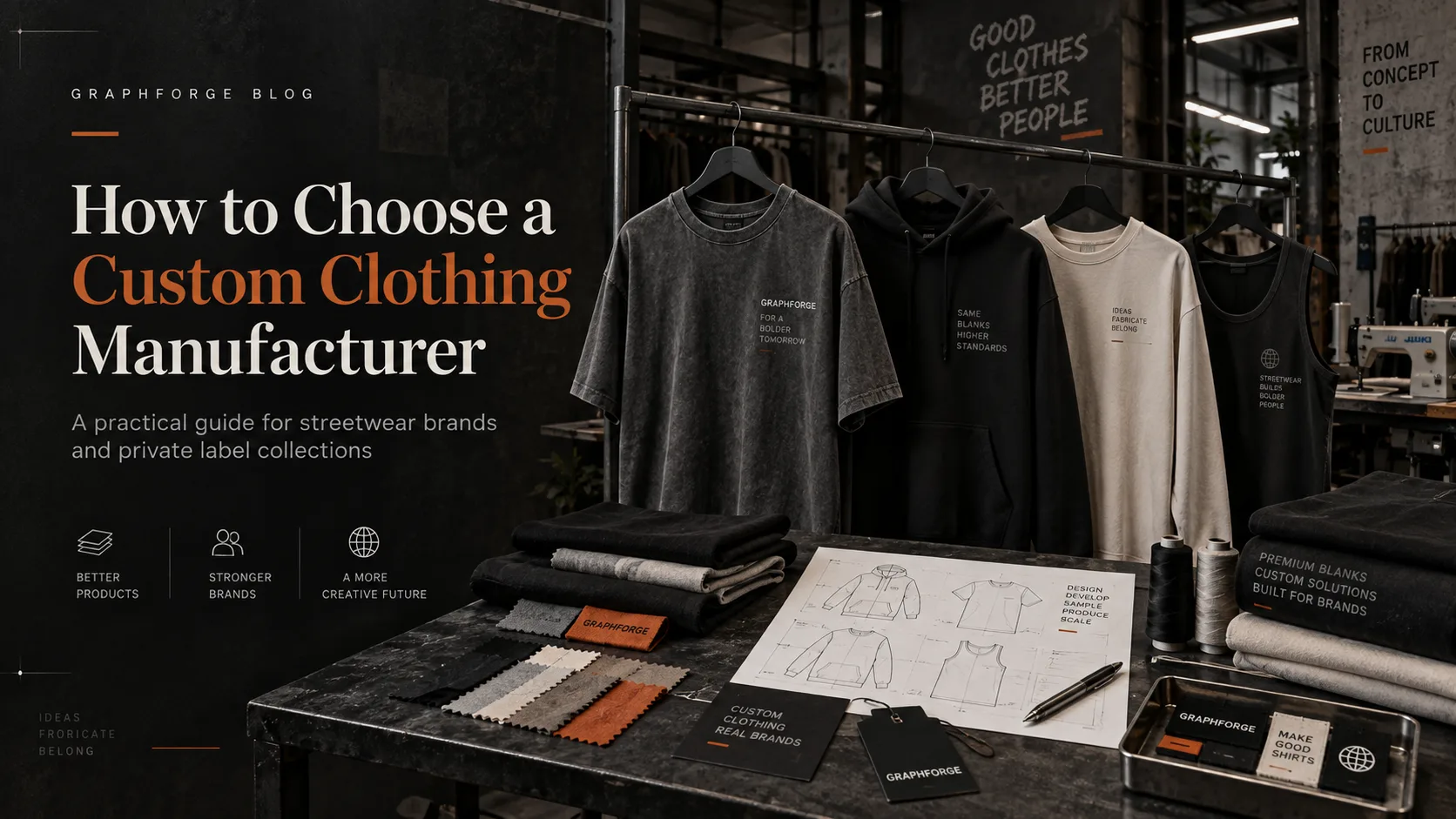
Finding the right custom clothing manufacturer is one of the most important decisions for any apparel brand. Whether you are launching a new streetwear label, expanding a private label collection, or developing a completely new clothing line, your manufacturing partner directly affects product quality, fit, fabric, printing, delivery time, and customer satisfaction.
A reliable manufacturer should do more than simply produce garments. They should understand your design direction, help develop the right materials and construction, support custom branding, and maintain consistent quality from sample to bulk production.
For streetwear and fashion brands in particular, details such as oversized fit, heavyweight fabrics, garment dye, acid wash, graphic printing, embroidery, labels, and packaging can determine whether a product feels generic or truly brand-specific.
This guide explains what to look for when choosing a custom clothing manufacturer and how to evaluate whether a factory is suitable for your brand.
What Is a Custom Clothing Manufacturer?
A custom clothing manufacturer produces garments according to a buyer’s specific requirements rather than selling only ready-made stock products.
Customization can include:
- Fabric type
- Fabric weight or GSM
- Garment color
- Fit and silhouette
- Pattern development
- Printing
- Embroidery
- Washing and finishing
- Neck labels
- Woven labels
- Hang tags
- Packaging
- Size specifications
For example, a streetwear brand may want a 280 GSM oversized T-shirt with dropped shoulders, custom garment dye, a large back screen print, branded neck labels, and individual packaging.
A true custom apparel manufacturer should be able to turn those requirements into a repeatable production process.
This is different from buying blank garments and adding a logo afterward. Full custom manufacturing gives brands more control over the final product.
Why Choosing the Right Manufacturer Matters
Your manufacturer is not only a supplier. In many cases, they become part of your product development team.
A weak manufacturing partner can create problems such as:
- Inconsistent sizing
- Poor fabric quality
- Incorrect colors
- Low-quality printing
- Delayed production
- Weak communication
- Different results between sample and bulk orders
A good custom clothing manufacturer should help reduce these risks.
The goal is not simply to find the lowest price. The better question is:
Can this manufacturer consistently produce the type of clothing your brand wants to sell?
For B2B buyers, reliability and production consistency are often more important than saving a small amount per piece.
1. Check the Manufacturer’s Product Specialization
Not every clothing factory is suitable for every category.
Some factories specialize in:
- Sportswear
- Workwear
- Formalwear
- Knitwear
- Streetwear
- Activewear
- Children’s clothing
If your brand focuses on streetwear, it is better to work with a manufacturer that regularly produces products such as:
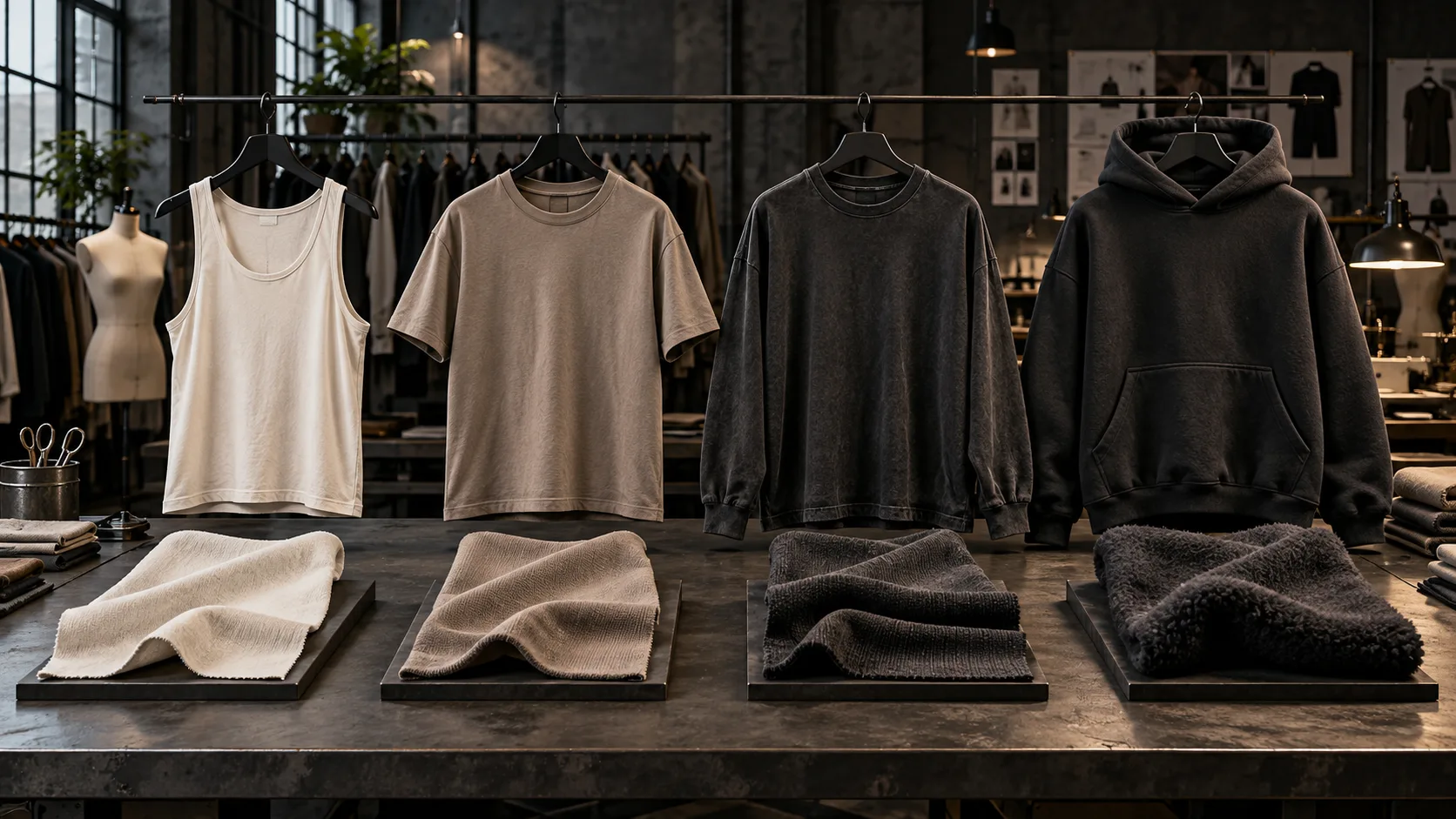
- Oversized T-shirts
- Heavyweight T-shirts
- Hoodies
- Sweatshirts
- Long sleeve T-shirts
- Tank tops
- Graphic apparel
A factory that understands streetwear will be more familiar with details such as drop shoulders, wide sleeves, boxy silhouettes, heavy fabrics, washed effects, and large graphic placements.
This experience can make product development much easier.
2. Ask About Fabric and GSM Customization
Fabric is one of the most important parts of clothing production.
A professional custom apparel manufacturer should offer different fabric options and weights depending on the product.
For example:
- 160–180 GSM for lightweight summer garments
- 200–220 GSM for standard T-shirts
- 240–260 GSM for heavyweight streetwear T-shirts
- 280–320 GSM and above for sweatshirts and hoodies
However, GSM alone does not determine quality.
You should also ask about:
- Cotton percentage
- Cotton-polyester blends
- French terry
- Fleece
- Jersey
- Rib fabric
- Stretch
- Shrinkage
- Hand feel
For premium streetwear, fabric structure and drape are extremely important.
A heavyweight T-shirt should feel substantial and structured without becoming uncomfortable.
3. Evaluate Fit Development Capability
Many brands focus heavily on graphics but underestimate the importance of fit.
For streetwear, fit can be one of the strongest brand identifiers.
Common options include:
- Regular fit
- Relaxed fit
- Oversized fit
- Boxy fit
- Cropped fit
- Drop shoulder
- Wide sleeve
A capable custom clothing manufacturer should be able to adjust measurements according to your requirements.
This includes:
- Body width
- Body length
- Shoulder width
- Sleeve width
- Sleeve length
- Armhole
- Neck opening
- Hem width
If you already have a measurement chart or tech pack, the factory should be able to follow it.
If not, an experienced manufacturer may help you develop a base size and revise it through sampling.
4. Review Printing and Embroidery Options
For many streetwear brands, graphic decoration is a major part of the product.
Your manufacturer should support the printing techniques that match your design style.
Screen Printing
Screen printing is widely used for streetwear graphics and is suitable for both small chest designs and large front or back prints.
Puff Printing
Puff print creates a raised three-dimensional effect and is popular for bold logos and graphic details.
DTF Printing
DTF printing offers flexibility for detailed and colorful artwork.
DTG Printing
DTG is useful for complex artwork and smaller production quantities, depending on fabric and design requirements.
Embroidery
Embroidery works well for chest logos, sleeve details, brand marks, and premium decoration.
A good manufacturer should explain which printing method is suitable for your artwork, fabric, quantity, and target result.
5. Ask About Washing and Finishing Techniques
Washing can completely change the appearance of a garment.
For streetwear brands, common finishing techniques include:
- Acid wash
- Garment dye
- Stone wash
- Enzyme wash
- Vintage wash
- Distressed finish
For example, an acid wash T-shirt should show visible tonal variation and a worn vintage appearance.
A garment-dyed long sleeve T-shirt should have rich color depth and subtle variation rather than looking like a standard piece-dyed garment.
If washed products are important to your brand, ask the factory to show previous samples.
6. Understand OEM, ODM, and Private Label Services
These terms are often used in apparel manufacturing, but they are not exactly the same.
OEM
OEM means the manufacturer produces according to your design, specifications, artwork, and requirements.
This is suitable for brands that already know exactly what they want.
ODM
ODM involves more development support from the manufacturer.
The factory may help with product ideas, construction, fit, fabric selection, and development.
Private Label
Private label manufacturing usually means producing products under your brand name.
This may include:
- Custom neck labels
- Woven labels
- Care labels
- Size labels
- Hang tags
- Packaging
Many brands use a combination of these services.
When evaluating a private label clothing manufacturer, make sure they can support the branding details you need.
7. Check the Minimum Order Quantity
MOQ is an important consideration, especially for new brands.
MOQ can vary depending on:
- Fabric
- Color
- Printing method
- Washing
- Size range
- Packaging
- Product complexity
Some manufacturers may offer lower MOQs for simple designs but require higher quantities for custom dyeing or special fabric development.
For small and growing brands, an MOQ around 50 pieces per style or color may be suitable for early-stage testing, depending on the project.
However, you should always confirm the actual MOQ with the factory before development begins.
8. Always Develop a Sample Before Bulk Production
Sampling is one of the most important parts of the manufacturing process.
A sample allows you to check:
- Fit
- Fabric
- Color
- Print size
- Graphic placement
- Stitching
- Washing
- Labels
- Overall construction
Do not approve bulk production based only on digital mockups.
Even small changes in shoulder width, sleeve length, print placement, or garment wash can significantly affect the final appearance.
A reliable custom clothing factory should provide a clear sampling and approval process.
9. Ask About Quality Control
Before choosing a manufacturer, ask how they manage quality during production.
Important quality points include:
- Fabric inspection
- Cutting accuracy
- Stitch consistency
- Measurement tolerance
- Print quality
- Embroidery quality
- Color consistency
- Washing consistency
- Final inspection
- Packaging inspection
Consistency is especially important for repeat orders.
A successful first order is good, but your manufacturer should also be able to reproduce the same quality later.
10. Evaluate Communication
Good communication is often underestimated.
Custom production requires many details, and misunderstandings can cause costly mistakes.
A professional manufacturer should clearly confirm:
- Product specifications
- Materials
- Colors
- Artwork
- Measurements
- MOQ
- Sampling
- Production time
- Packaging
- Shipping
If communication is slow or unclear during the inquiry stage, it may become more difficult during production.
The best supplier relationships are built on clear specifications and consistent updates.
11. Consider Production Capacity and Lead Time
Ask the manufacturer about their normal capacity and production lead time.
Important questions include:
- How long does sampling take?
- How long does bulk production take?
- Can production scale if order quantities increase?
- Can the factory handle repeat orders?
- How are urgent orders managed?
Your production partner should be able to support your growth.
A factory that works well for 50 pieces should ideally also be able to support larger orders later.
Questions to Ask a Custom Clothing Manufacturer
Before placing an order, consider asking these questions:
- What products do you specialize in?
- What is your MOQ?
- Can you customize fabric weight?
- Can you develop oversized and boxy fits?
- What printing methods do you offer?
- Do you provide embroidery?
- Can you produce acid wash or garment-dyed products?
- Can you make custom neck labels and woven labels?
- Do you provide custom packaging?
- Can I order a sample before bulk production?
- What is your normal lead time?
- How do you control quality?
- Can you support repeat orders?
These questions can help you quickly understand whether a manufacturer fits your requirements.
Why Work With a Direct Custom Clothing Manufacturer?
Working directly with a manufacturer can provide several advantages.
First, communication about technical requirements is usually more direct.
Second, custom development becomes easier because the production team understands fabric, pattern, sewing, printing, washing, and finishing.
Third, brands may have more flexibility when developing products.
A direct manufacturer can potentially support the full process:
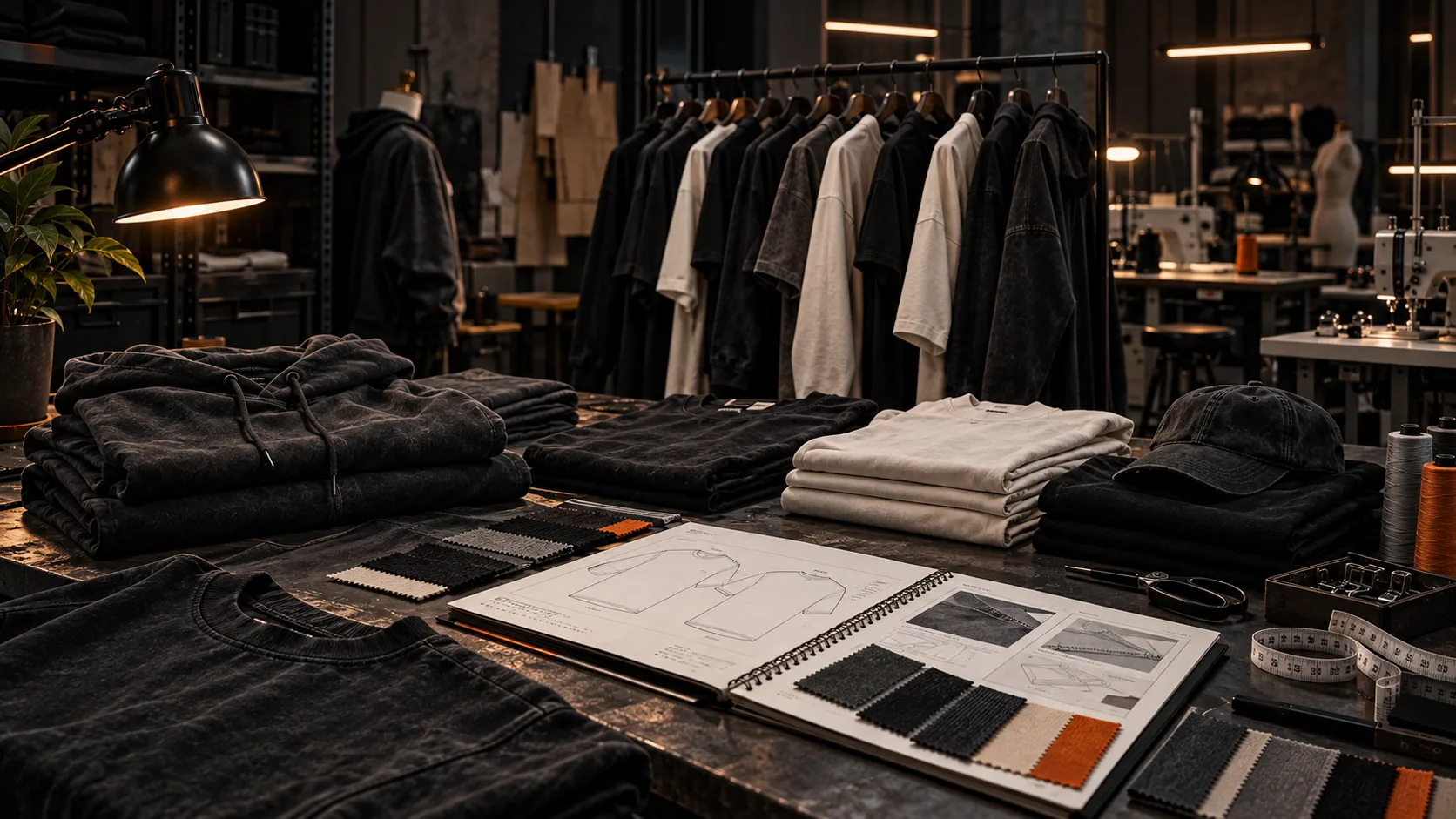
Design → Fabric → Fit → Sample → Printing → Washing → Labels → Packaging → Bulk Production
This type of integrated production process is especially useful for brands developing custom streetwear collections.
Custom Streetwear Manufacturing at GRAPHFORGE
GRAPHFORGE focuses on custom streetwear production for brands, private labels, teams, and apparel buyers.
Our product categories include:
- T-Shirts
- Hoodies & Sweatshirts
- Long Sleeve T-Shirts
- Tank Tops
Customization options can include:
- Oversized and boxy fits
- Heavyweight fabrics
- Custom GSM
- Acid wash
- Garment dye
- Screen printing
- Puff printing
- DTF printing
- Embroidery
- Custom neck labels
- Woven labels
- Hang tags
- Branded packaging
From sampling to bulk production, each product can be developed according to your collection requirements.
Conclusion
Choosing the right custom clothing manufacturer requires more than comparing prices.
You should evaluate the factory’s product specialization, fabric options, fit development, printing capabilities, washing techniques, MOQ, sampling process, quality control, communication, and production capacity.
For streetwear brands, the best manufacturing partner is one that understands how fabric, fit, graphics, washing, and branding work together.
A strong manufacturer should help turn your idea into a product that can be consistently reproduced at scale.
If you are developing a new streetwear collection, prepare your artwork, reference images, target quantity, preferred fabric weight, and fit requirements before contacting a supplier.
The more information you provide, the easier it becomes for a manufacturer to recommend the right production solution.
Looking for a Custom Clothing Manufacturer?
Send us your product idea, artwork, target quantity, fabric preferences, and fit requirements.
We can support your project from sampling to bulk production.
GET A QUOTE →
Ready to start your production run?
Send us your design, quantity and target delivery date. We will reply with a clear quote and a sample timeline within 48 hours.